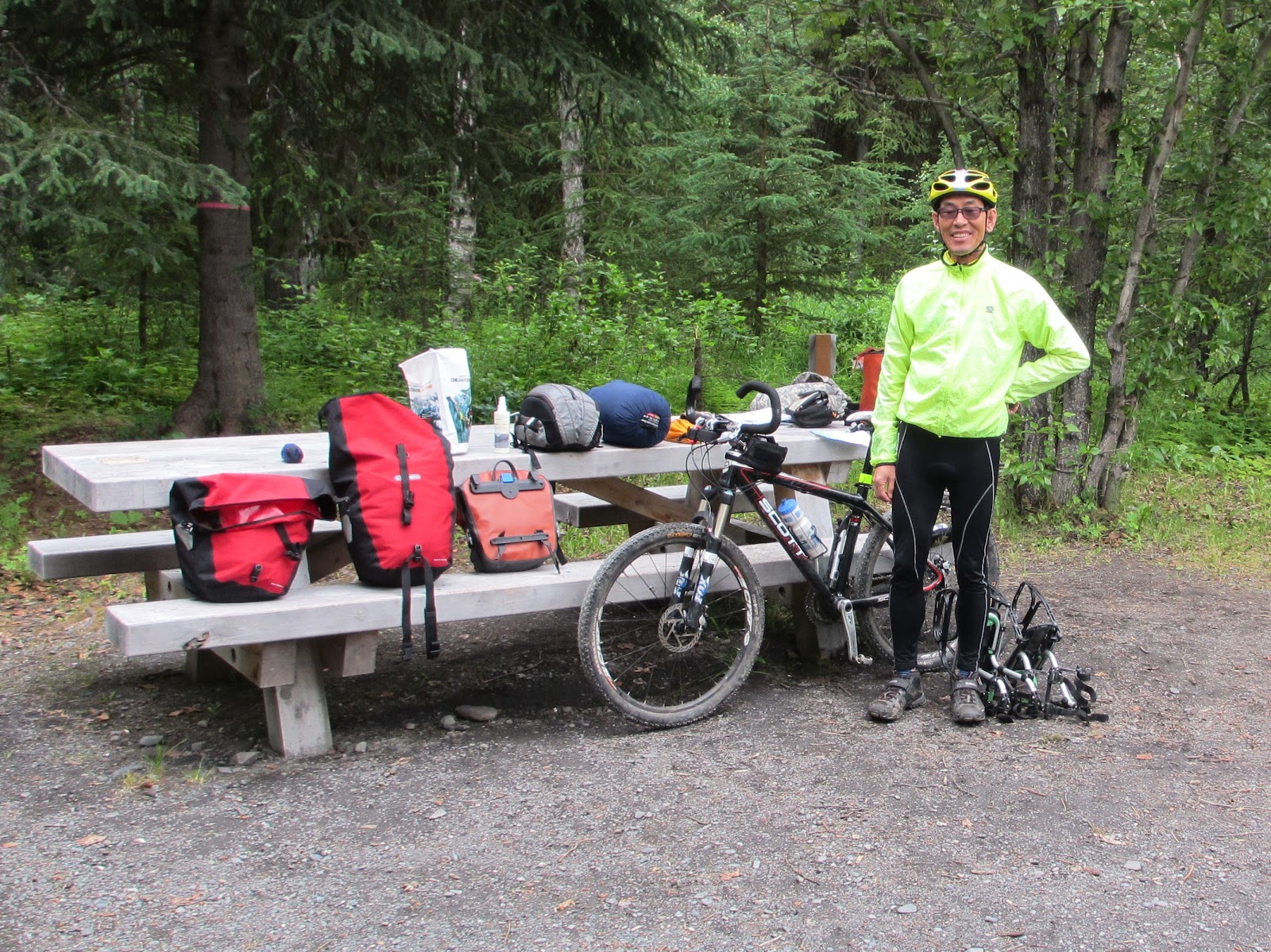
Since the campground here at Denali was full, we offered to share our campsite with two long-distance bicyclists. The first one was a young man named Eddie from Maryland who is biking from Anchorage to Prudhoe Bay up at the Arctic Ocean. He said he wanted to touch the water. Several years before, he had biked from the Atlantic to the Pacific (Delaware to Washington). We gave him a beer and a place to pitch his tiny bivouac bag and then wished him well the next morning. He was headed to Fairbanks from here (about 120 miles) and then on to Prudhoe Bay which is 80 miles on a paved road and then almost 400 on the gravel Dalton Highway. Once he gets there, a friend is going to pick him up and drive him back to Anchorage. He is going to text us when he makes it to the Arctic Ocean. When we hear from him, we'll post it here on the blog.
Here is Eddie with his little tent/sleeping bag called a bivouac bag. He said the hardest part was getting in the thing! It rained the night he was at our site but I think he stayed dry.
Here is Eddie starting out to Fairbanks. Note that he has a spare tire on the back on his bags. He will probably need it on the 396 mile gravel road to Prudhoe Bay.
The next night, we shared our campsite with a Korean cyclist named Park. We had met him at Cooper River South campground in the Kenai Peninsula earlier in the month and he was now spending a few days at Denali. He is biking all over Alaska. He is 59 years old and has biked all over the world. We're not sure how he find enough energy to do all that biking.
Sunday, July 22, 2012
Visiting Sled Dogs at Denali
Denali National Park is the only national park to have working sled dogs. They use them in the winter to get to outlying areas of this vast two million acre park. Since this is a legally designated Wilderness, there are no mechanized forms of transport allowed -- no snowmobiles, no cars, no airplane landings and no motors. They told us that when the park has a choice between flying a load into a remote location or using the dog teams, they will use the park sled dogs when feasible. These "athletes" as they called the sled dogs when we visited the Iditarod Headquarters in Wasilla, are kept in kennels near the main park visitor's center. They have tours several times a day where you can meet the dogs and see a sled dog demonstration. Here are our pictures from there:
Monday, July 16, 2012
Mt. St. Helen's photos -- May 2012
We visited Mt. St. Helen's in southwestern Washington in May. This is what the mountain looks like now. The entire top third of the mountain came off. It used to be a perfect volcano cone. The main portion of the top slid down at over 150 miles per hour, and slid up to seven miles away. Hot gasses, pulverized rock and lava were blown beyond the mountain top.
Here we are at the Visitor's Center, which was built after the eruption. David Johnston, the vulcanologist who was killed was monitoring the steaming and smoking volcano at this site which is 6 miles from the volcano. He was one of the principal scientists on the monitoring team and was manning an observation post here. He was the first to report the eruption, transmitting the message "Vancouver! Vancouver! This is it!" before being swept away by the lateral blast created by the collapse of the mountain's north flank. The Visitor's Center is named in his honor.
This is a tree trunk on display in the Visitor's Center. The power and force of the blast killed everything in its path. This tree remained rooted but its top was broken off and hurled down the mountain. The bark still remained on the side away from the blast, but was completely stripped on the blast side.
The 1980 eruption of Mount St. Helen was a major volcanic eruption. An earthquake on Sunday, May 18, 1980, caused the entire weakened north face to slide away, suddenly exposing the partly molten, gas- and steam-rich rock in the volcano to lower pressure. The rock responded by exploding a hot mix of lava and pulverized older rock toward Spirit Lake so fast that it overtook the cascading north face. An eruption column rose 80,000 feet (24,400 m) into the atmosphere and deposited ash in 11 U.S. states. At the same time, snow, ice and several entire glaciers on the volcano melted, forming a series of large volcanic mudslides that reached as far as the Columbia River, nearly fifty miles (eighty kilometers) to the southwest. Fifty-seven people and thousands of animals were killed. Hundreds of square miles were reduced to wasteland. Mount St. Helen's was left with a crater on its north side.
This is a tree trunk on display in the Visitor's Center. The power and force of the blast killed everything in its path. This tree remained rooted but its top was broken off and hurled down the mountain. The bark still remained on the side away from the blast, but was completely stripped on the blast side.
The force of the blast buried this tree in the ground miles away. Looking at the hillsides in the blast area in the 7 mile range from the mountain, trees were neatly blown over so that they all lay with their tops pointing away from the blast. Nature can be unbelievable powerful. The town of Valdez, Alaska which we visited in June was completely wiped out by the 1964 earthquake. It leaves us in awe.
FYI: Here is an abbreviated Wikipedia description of the eruption:
The 1980 eruption of Mount St. Helen was a major volcanic eruption. An earthquake on Sunday, May 18, 1980, caused the entire weakened north face to slide away, suddenly exposing the partly molten, gas- and steam-rich rock in the volcano to lower pressure. The rock responded by exploding a hot mix of lava and pulverized older rock toward Spirit Lake so fast that it overtook the cascading north face. An eruption column rose 80,000 feet (24,400 m) into the atmosphere and deposited ash in 11 U.S. states. At the same time, snow, ice and several entire glaciers on the volcano melted, forming a series of large volcanic mudslides that reached as far as the Columbia River, nearly fifty miles (eighty kilometers) to the southwest. Fifty-seven people and thousands of animals were killed. Hundreds of square miles were reduced to wasteland. Mount St. Helen's was left with a crater on its north side.
Sally & Bill
Sally's Perilous Hike With Her Photographer
There are mountain ridges on both sides of the pass, and Sally decided to try to hike up on the south side with her photographer. Her first challenge was a steep snow field that she had to cross. Sally was making good foot holds in the snow on the way across as she did not want to go tumbling down. And, of course, her photographer did not want to go tumbling down and lose the camera.
Once across the snow field, Sally continued through a series of switchbacks up to the top of the ridge. From there she was able to hike along a long mountain ridge which dropped off on both sides providing spectacular views of the mountains on all sides.
Along the hike we spotted a Hoary Marmot at the very top of the ridge scurrying around for food. When he realized he had company, he froze so his picture could be taken, then scurried back into one of his holes.
On the way across we also saw a ptarmigan which blended in with her surroundings perfectly. She did not move as we walked by which we thought was odd, as if she was protecting something. On the way back, there were two small chicks about 40% of her size. They scurried for cover, but she stood her ground, protecting her brood.
Toward the end of the ridge traverse, the camera tripod was set up on the trekking poles, and Sally got a picture of herself with her photographer.
Also, the snow fields that we crossed at first had people sliding down them on their backs. They were having a great time.
We are in Talkeetna now, a small aging-hippy-type village near Denali. You see a lot of tourists but also some Real Alaskans following the subsistence lifestyle which is very popular up here. We are off to the national park tomorrow.
by Bill, the photographer
P.S. to our children: Don't worry, kids. We're not doing anything dangerous! We are VERY cautious.
Sunday, July 8, 2012
Rita and the Big Rigs
We are camping right on the waterfront here in Seward, Alaska. Can you pick out Little Rita sandwiched between all the Big Rigs??
Our stay in Seward, Alaska
In addition to watching the Mt. Marathon Race, we have hiked and sea kayaked here in Seward. Yesterday we hiked part way up the trail to Mt. Alice. This is a hike which only the locals seem to know about. A woman we stood next to us at the race told us about it. She told us the road it was on but when we drove down there, there was no trail marker. We finally asked a local fisherman down at the boat launch ramp, and he ended up leading us back to the trailhead which turned out to be a muddy place leading steeply up into the woods on the side of the road. Once we got up the ravine on the side of the road, we were in the rain forest and on a pretty decently maintained trail. Here is a photo of all the moss on the trees. As you can see, the trees were just "dripping" with moss. Luckily, it was not raining, too.
We hiked UP this steep trail until we came to the snow. Since we were the only ones there and it was deep in the woods, we had our bear spray. To make plenty of noise, we talked, sang, and clicked our hiking poles together. Luckily, we did not encounter any bears or see any signs of them. We lost the trail once we got to the snowline. The snow got pretty deep, so we decided to stop there. We ate our lunch and hiked back down. Here is a photo of Bill at the snow line. We never did make it up to Mt. Alice.
The next day we did a 5 mile sea kayaking trip out to Caines Head State Park. We went with a very young guide and a family from Charleston, SC. The company would not let us rent the kayaks by ourselves. They insisted that we have a guide since we were not experts in cold water rescue. Somehow we didn't feel very confident once we saw our guide -- a nice enough young college student who had only been in Alaska since May. Anyway, it turned out to be a very nice sea kayaking adventure, in spite of a light rain. Bill says: as we were beaching the tandem kayak that we were in, I managed to turn it sideways which was not the preferred orientation. A wave arrived simultaneously and washed over Sally's end of the kayak and into her non waterproof kayaking skirt. She got soaked. Bill was to blame. It was cold. Cotton kills. A forgotten part of her wardrobe was cotton. Sally was not a happy camper. I was made aware she was not happy. In the end, all turned out well.
At the end of the trip, when we were on the boat for our water taxi ride back to the dock, we saw two humpback whales. The captain got the boat close enough that we could actually smell their "breath" when they sprayed out of their Blow Hole. It smelled sort of like fishy sewer gas!!
We will try to post a whale photo later. It does not seem to be downloading now on this weak WiFi network.
Sally
Incredible Mount Marathon Three Mile Race
The race goes up the mountain for 1.75 miles for an elevation gain of over 2900 feet. There is significant leeway on how you get up to the top and back down. Top people take over 34 minutes to get up, and just over 10 to get back down.
In the two pictures above a stream of people going up the mountain is visible, and I have enlarged the stream in the second picture. Looking at the snow to the right of the people, they use that as their highway to get down. Going more than 3 times faster going down, you can imagine how they shoot through the snow, sliding all of the way. They also do a lot of sliding on the scree slopes. We also saw tumbles and rolls. It is a very treacherous race. The day of the race there was a light rain off and on so the sharp shale was also slippery. There were a lot of cuts and bruises, but it did not show on the faces of the contestants.
Above is the women's first place finisher, Holly Brooks. Holly was on the 2010 Olympic Ski Team for cross country skiing.
When she came off of the mountain, she was running hard and with assurance, accompanied by a big grin on her face. There was no one close to her. I caught her picture and blew up her legs when I noticed damage. Notice the outside of her left leg in the pic. I have also included a picture of another woman who happened to be a friend of a woman standing next to us. Her right leg was bleeding. I guess these are the normal hazards of coming down the mountain fast. These pictures are a testament to how much these contestants love competition and how much they are willing to push themselves. Very impressive.
I have a video of a man who finished 8th. He looked like he came down the mountain fairly unscathed. As he was going down the last slope, he vaulted over a boulder, got bad footing when he landed and fell, landing on his chest which ruined a good ending. Normal for this race are bumps and bruises, but a tragedy is still unfolding in this race. It is Saturday afternoon now, and the race was held on Wednesday. A 66 year old man has been missing and was last seen at the check point at the top of the mountain. He was trailing the field, and they believe he got disoriented and went the wrong way, or possibly fell into some area where it has been very difficult to find him. It has been raining at least half of the time and the temperatures have been in the low forties. There is a 35 person search team supported by dogs and helicopters. This is a horrible turn of events to something that started out as being very exciting and amazing. Since this mountain juts above the town, it has put a damper on everything.
Sunday update: We also just heard that another man had tumbled down the cliff at the bottom and is in the hospital with a broken leg and serious head injuries. This has been overshadowed by the missing man for whom they have just called off the search.
Bill
Subscribe to:
Posts (Atom)